
12/11/2024
Sinterklaas celebration
Last week, Sinterklaas visited Taminiau Lab! According to Dutch tradition, we exchanged gifts an poems. There were games and soup and of course a lot of pepernoten.
11/9/2024
Guido defends his PhD
On the 6th of November, Guido van de Stolpe defended his PhD thesis successfully. Congratulations, Dr. Guido!

11/5/2024
TU Delft Science Day
Last weekend, TU Delft’s Science Day took place. Science Day is a free science festival which attracts a few thousand kids with their parents annually, with the goal of discovering science and technology from all angles. It is a day full of inspiring activities, including workshops, demonstrations, shows and tours.
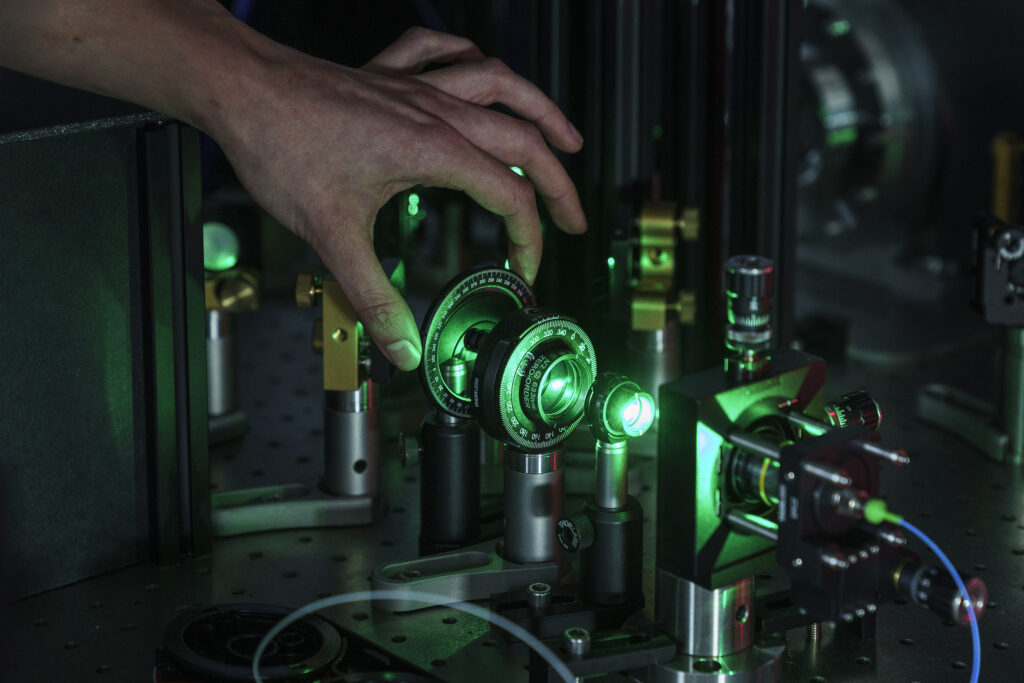
Taminiau Lab also had a stand with two optical setups, supervised by Margriet, Sara and Naoual, and Sam from the QMAI group. The kids could try aligning an optical setup and move around a sample under an objective. The goal was to make everyone experience what it’s like to be a physicist, and it’s safe to say it was a success!
9/18/2024
Diamond Cup Sports Day
On the 9th of September Taminiau lab participated in the annual Diamond Cup Sport day along with Hanson Lab. Organized by the students, it was a day full of sports, celebrating its conclusion with a BBQ!

7/12/2024
Sjoerd graduates!
On the 12th of July, Sjoerd Loenen defended his PhD thesis successfully. Congratulations, Dr. Sjoerd!
11/17/2023
Opening of NanoArt exhibition: Lens(less)ness
The NanoArt project of QuTech, initiated by Laurens Feije and Gerben Timmer from Taminiau Lab, had its first large-scale exhibition at the TU Delft Library. NanoArt brings the beauty of cleanroom work to the public. This exhibition featured art pieces not only from Laurens and Gerben, but also from QuTech colleagues David van Driel, Figen Yilmaz, Marta Pita Vidal, Nina Codreanu, Nick van Loo and Siddharth Singh.
10/13/2023
Hans defends his PhD successfully
On October 13th 2023, Hans defended his PhD successfully! Congrats, Hans!
3/20/2022
Antoni van Leeuwenhoek lezing in the Delft theatre
Sjoerd Loenen, PhD student in Taminiau Lab, gave a lecture for Studium Generale in the Delft theatre ‘Theater the Veste’, about the impact and power of quantum technology. See https://sg.tudelft.nl/event/kwantumtechnologie-ongekende-rekenkracht-fascinerende-natuurkunde/ (in Dutch).
11/24/2021
Conor defends his PhD
Conor has defended his PhD and was awarded cum laude. Congrats Conor!!
11/24/2021
Our realisation of a time crystal is published in Science
Researchers from the Taminiau lab at QuTech created a time crystal, a novel exotic quantum phase of matter, using a quantum computer based on diamond. Together with a simultaneous experiment by Google (preprint), the results shed new light on the physics of out-of-equilibrium quantum systems. The team reports their findings today in Science.
Collaboration with Element Six, Francisco Machado and Norman Yao.
10/7/2021
Mohamed is awarded a prestigious Rubicon fellowship
NWO announced today that QuTech’s Mohamed Abobeih will receive a Rubicon grant. The Rubicon programme gives young, highly promising researchers the opportunity to gain international research experience.
Mohamed will use the fellowship to join the group of Mikhail Lukin at Harvard in the near future.
Congrats Mohamed!
10/7/2021
Maarten successfully defended his PhD thesis
On Monday the 12th of April, Maarten has defended his PhD thesis with great success. Congratulations Maarten and best of luck with your new adventures.
1/21/2021
Mohamed graduates!
Today, Mohamed has successfully defended his thesis after a fascinating discussion with his committee. Congratulations to Dr. Mohamed on a job well done!
11/18/2020
Kavli Institute of Nanoscience Delft Publication Prize
Our paper on the atomic-scale imaging of a large nuclear spin cluster has been awarded the prestigious and biennial Kavli Delft Publication Prize. Congrats Mohamed, Joe, Conor and all co-authors.
10/19/2020
Launching a research collaboration with Fujitsu
QuTech has launched a research collaboration with Fujitsu to investigate modular optically-connected quantum computation. Teaming up with a partner with a strong expertise in computing and electronics is excepted to accelerate research and create new opportunities for valorisation. The collaboration includes 8 groups within QuTech. See the press release or this story in the Delta for more information.
12/19/2019
Our atomic-scale magnetic imaging is published in Nature
“Researchers at QuTech, a collaboration of TU Delft and TNO, have developed a new magnetic quantum sensing technology that can image samples with atomic-scale resolution. It opens the door towards imaging individual molecules, like proteins and other complex systems, atom by atom. The team reports on their results today in Nature.”
Article in Nature
Press release QuTech
Press release TuDelft
Video explaining the paper
12/19/2019
ERC starting grant
The European Research Council has awarded an ERC Starting Grant to Tim Taminiau. The grant (1.5 million euros for a five-year program) will allow him to pursue ground-breaking ideas for the next generation of quantum computing.
8/3/2019
NWA grant
Our proposal “Quantum microscopy: A new tool for future technologies” has been accepted (NWO website). We will investigate scanning probe magnetic imaging based on defects in diamond with a multi-disciplinary team that includes Toeno van der Sar (Delft), Richard Norte (Delft), Tjerk Oosterkamp (Leiden), TNO, Applied Nanolayers BV and Leiden Spin Imaging BV.
NWA: Connecting science and society.
The Dutch government has recently increased its investment in research and innovation. Part of this extra funding is intended for the NWA research programme that NWO is realising on behalf of the Ministry of Education, Culture and Science. The overarching aim of this programme is to improve the connection between science and society. The need to structurally strengthen this connection is widely felt and supported. To achieve this aim, the NWA programme will encourage research relevant for society, facilitate knowledge sharing via interdisciplinary and knowledge-chain-wide collaboration, and proactively involve societal partners in the formulation, setting up and realisation of the research. The dialogue between science and society will be further fuelled by targeted communication and outreach activities and by the active involvement of citizens in science and research (e.g. through citizen science and co-creation). In addition, the programme will contribute to the sustainability and innovativeness of routes and networks.
6/6/2019
Poster prize!
Mohamed wins the LATSIS2019 diamond photonics poster prize! Congrats! Click here for the corresponding paper.
2/15/2019
Radio interview on NPO1 (Dutch)
Tim gives his take on a recent breakthrough paper on the Dutch radio. Click here for the radio interview. In the paper, published today in Science, the authors demonstrate that single NV centers can be read out through the electrical current they generate. This provides an alternative to the traditional optical readout, with the potential for better integration is small electronics devices. Fun fact: one of the authors is Takashi, who now joined our team at QuTech.
9/15/2017
Minerva prize
Julia wins the NWO Minerva prize for our error correction paper. Congratulations Julia!
The prize will be given to Julia at the Veldhoven conference.
12/20/2016
Julia has graduated!
Julia becomes the first PhD graduate of the group. Congratulations Julia!
On the right: Julia, her paranymphs, and the commitee (Fedor Jelezko, Barbara Terhal, Koen Bertels, Lieven Vandersypen, Ronald Hanson and Tim Taminiau).
12/6/2016
The Bell paper wins the Ehrenfest prize for Quantum Foundations
Our loophole-free Bell test has been awarded the Ehrenfest Prize for best publication on the foundations of quantum mechanics. Below: Tim receiving the certificate from Caslav Brukner in Vienna.
11/29/2016
Interview with Tim about the Big Bell test in El Periodico
Tim shares his opinion about the upcoming “Big Bell test” in an interview with the major Spanish newspaper. Don’t forget to play the Bell game today and tomorrow (30 November 2017), and see how random you can be!
11/29/2016
Quantum Zeno dynamics published
Our paper on protecting logical quantum states in subspaces formed through the quantum Zeno effect is published in Nature Communications. The work explores protecting multiple logical entangled qubits from environmental noise and provides an opportunity to study the interplay between frequent quantum measurement and correlated noise such as non-Markovian noise.
See the press release and these selected news articles (Tweakers, PhysOrg) for more.
9/10/2016
Kavli publication prize 2016
The Bell paper wins the Kavli publication prize for the best publication of the Kavli Institute of Nanoscience Delft of the last two years. Congratulations Bas and all co-authors!
On the right: Kavli directors Cees Dekker and Lieven Vandersypen hand over the Kavli publication prize to the present authors (left to right: Raymond Schouten, Raymond Vermeulen, Tim Taminiau, Ronald Hanson, Bas Hensen). The prize consists of 3000 Euros and a cool statue.
5/17/2016
Royal attention
5/7/2016
Quantum Error Correction published in Nature Communications
Because quantum states are extremely fragile, large-scale quantum information processing is impossible without quantum error correction. In our latest publication in Nature Communications we realize active quantum error correction based on non-destructive measurements and real time feedback. This experiments marks the first time that quantum states are continuously protected by repeatedly detecting errors and actively corrected through classical logic and real time feedback, essential elements of fault-tolerant quantum computations.
The work was covered by several media, such as the volkskrant, tweakers.net and BNR radio, and even drew the attention of the Dutch royal family! See the videos and cartoon below for a basic explanation of quantum error correction.
3/15/2016
Interview: cover story in SURF magazine about our work
Tim describes our work on quantum computing and quantum networks in a cover story in SURF magazine.
12/21/2015
Top 10 scientific breakthrough!
Our loophole-free Bell test was picked as a top 10 scientific breakthrough of 2015 by the magazine Science. Ultimately we lost out on the number 1 spot to CRISPR, the powerful genome editing technique. In the internet voting by the public, the New Horizons missions images of Pluto took first place, with our Bell test coming in 5th!
Just a few days later Nature selected our experiment as one of the science events that shaped 2015!
11/12/2015
Our new labs are ready!
The renovation is finished and all three new labs look great (B-56, B-58 and B-60). Next step: constructing the experiments and doing science (after cleaning of course).
10/22/2015
The first loophole-free Bell test
Our loophole-free Bell test has now been published in Nature. In this experiment performed at the Hanson lab we entangled two nitrogen-vacancy (NV) centers in diamonds placed in laboratories on opposite sides of the TU Delft campus (1.3 kilometer). We then used this entanglement to demonstrate a violation of Bell’s inequality. Because the NV center spins were measured with high accuracy and because the complete measurement (choice of measurement basis, spin readout, storage of result in classical electronics) was performed in a time so short that no communication between the labs was possible, the experiment closes all loopholes that were present in previous experiments.
Our results reject the hypothesis that nature obeys the principle of local causality (or local realism), providing the strongest evidence yet that the world is fundamentally non local. The only remaining ways to save the local casual worldview is to invoke that the measurement choice was already determined at an earlier time or that the results stored were still altered after they were saved in the classical computers. Such theories can be further restricted in future experiments – most excitingly by using humans on earth and on the moon/in space to select the measurement settings and record the data – but can never be completely excluded.
The result made quite a splash in the media and was even featured on the cover of the New York Times. A good place to start is the coverage by the economist and two of the features by Nature (first, second).
This experiment was based in the Hanson lab at QuTech and is a collaboration with the groups of Stephanie Wehner (QuTech), Morgan Mitchell (ICFO), Valerio Pruneri (ICFO) and Matthew Markham and Daniel Twitchen (Element Six).
6/25/2015
Tim Taminiau is awarded the Fresnel prize for fundamental research
Last week Tim was presented the Fresnel prize during a ceremony at the CLEO in Munich. The Fresnel prize for fundamental research is awarded bi-annually by the European Physical Society to a researcher that made outstanding contributions before the age of 35. Previous recipients include Markus Aspelmeyer, Tobias Kippenberg, Philip Walther and Kjeld Eikema.