12.02.2026Qubit Research
QuTech demonstrates real-time readout for Majoranas
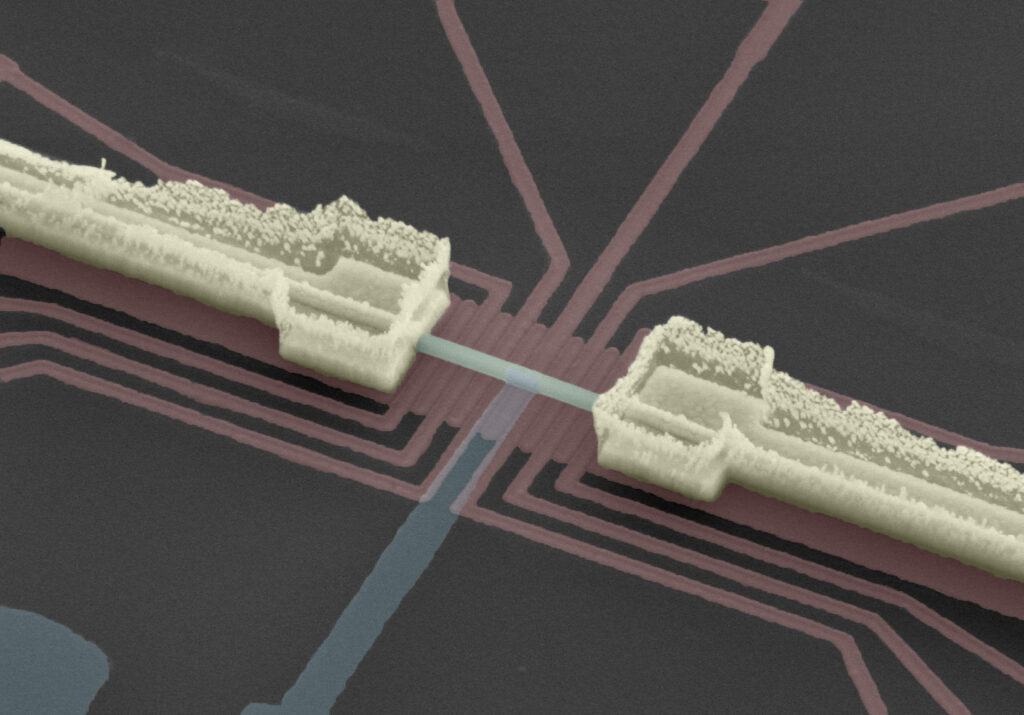

Researchers at QuTech have demonstrated a fast, single-shot readout of fermionic parity, the non-local quantity that carries information in Majorana-based qubits. This capability is an essential step toward operating Majorana modes as qubits, because it enables initialisation and real-time tracking of the encoded state in a qubit-style device geometry. By establishing direct parity readout, the work moves Majorana based platforms closer to the demonstration of a qubit. The results are published in Nature.
A missing readout step
Majorana-based qubits aim to store information non-locally, which is to say: across separated so-called ‘Majorana zero modes’. A single pair encodes a parity bit, while a pair of parity bits forms the qubit (so together four Majorana zero modes). This ensures that disturbances, to which ordinary qubits are very vulnerable, will have limited access to the information stored in the qubits. However, that same limited access makes measurement difficult, because a probe that couples to only one end of the device cannot, in principle, reveal the parity state that defines the qubit.
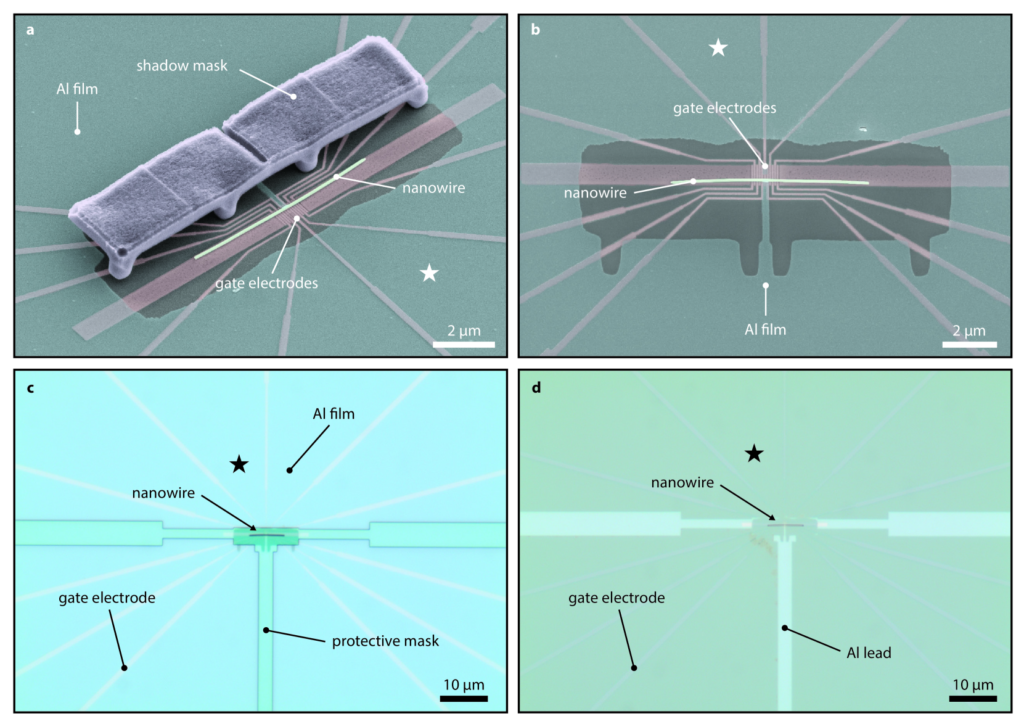
In the paper, the QuTech-team manufactured a minimal Kitaev chain using two quantum dots coupled through a superconducting segment – which creates two Majorana modes on either end of the chain – and read out parity using quantum capacitance. The readout is performed through an RF resonator connected to the superconductor, which senses the joint state of the two-dot system by measuring how charge can flow into and out of the superconducting condensate.
From charge sensing to quantum capacitance
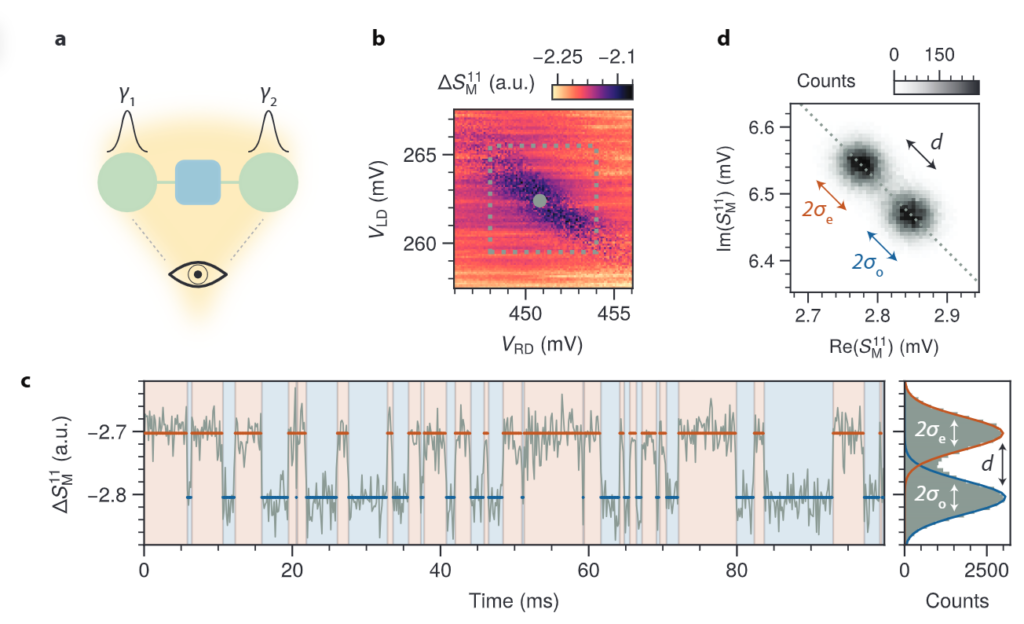
“Getting this to work required us to tune the device into the regime where Majorana modes form and then isolate it so the parity is not constantly disturbed by the leads,” says Nick van Loo. “A key challenge is that the parity states are effectively charge-neutral, so the standard charge-sensor approach used for spin qubits cannot, by itself, provide a robust readout. We used the charge sensor to verify that limitation, and then developed a readout that can couple the two modes through an observable of the detector. The intuition is simple: in an even-parity state the device holds an even number of electrons that can pair up and enter the superconductor together as a Cooper pair, while in an odd-parity state a lone electron lacks a partner and cannot enter in the same way. That difference changes how charge can flow into the superconductor under an RF drive, which shows up as a measurable change in quantum capacitance. With the quantum-capacitance measurement via the superconductor, we can discriminate parity in single shots and measure millisecond-scale parity lifetimes, which brings time-domain experiments within reach.”
The team recorded a standard charge sensor at the same time as the quantum-capacitance signal from the superconductor to benchmark the readout against techniques commonly used in spin-qubit devices. Near the operating point, the charge sensor shows little or no response because the two parity states are effectively charge-neutral, a key property expected for Majorana-based states. In contrast, the quantum-capacitance measurement provides a clear, single-shot discrimination of parity, because it is sensitive to whether electrons can move into the superconductor as Cooper pairs under the RF excitation. The measurements reveal random telegraph switching between parity states and allow the researchers to extract parity lifetimes exceeding one millisecond, with single-shot readout on microsecond timescales.
Shadow lithography with masks grown on-chip
From readout to operations
“This is the measurement primitive protected qubits have been missing,” concludes Francesco Zatelli, co-author of the paper. “If you want to build qubits from Majorana zero modes, you must be able to read out parity in real time and in a scalable way. This result puts that capability on a solid experimental footing and sets the stage for the next steps.”
The team stresses that significant work remains before Majorana-based qubits can be used as computing elements. The next milestone is the demonstration of coherence, and after that specific experiments that demonstrate the exotic, non-abelian nature of Majorana modes: fusion and braiding. In parallel, QuTech continues to work on extending device concepts toward larger systems, including efforts to increase the distance between modes for even more resistance against disturbances.