12.11.2026Awards
Team science for spin qubits: four Delft researchers get ERC Synergy Grant


From your phone to your laptop: modern computers process information by switching electrical signals through billions of tiny transistors on microchips. A new project at QuTech and TU Delft will build on the physics, materials and engineering behind these chips to explore how quantum information can be processed on a large scale. The six-year project, called UniQ, is funded by a European Research Council (ERC) Synergy Grant.
The appeal of spin qubits is that they could bring the power of semiconductor engineering to quantum computing. Their small size offers room for large numbers on a chip, while their compatibility with chip manufacturing opens the door to decades of engineering expertise. UniQ will explore how to turn that promise into a working system by developing the scaleable qubit architectures, the materials that host them, and their supporting electronics together. The ambition is to build processors that can grow while preserving the fragile quantum information they carry.
From physical qubits to logical ones
Protecting the fragile quantum information necessary for meaningful quantum computation, requires that qubits work together. It is a demanding form of teamwork: the qubits must interact with the right partners, the electronics must deliver carefully shaped signals, and measurements must reveal errors without destroying the information being protected. For Menno Veldhorst, now is the right time to work on this challenge. “Spin qubits are reaching an inflection point,” he says. “We can control them increasingly well, and we are learning how to connect and move them. That gives us a much richer starting point for building the logical qubits we ultimately need.”
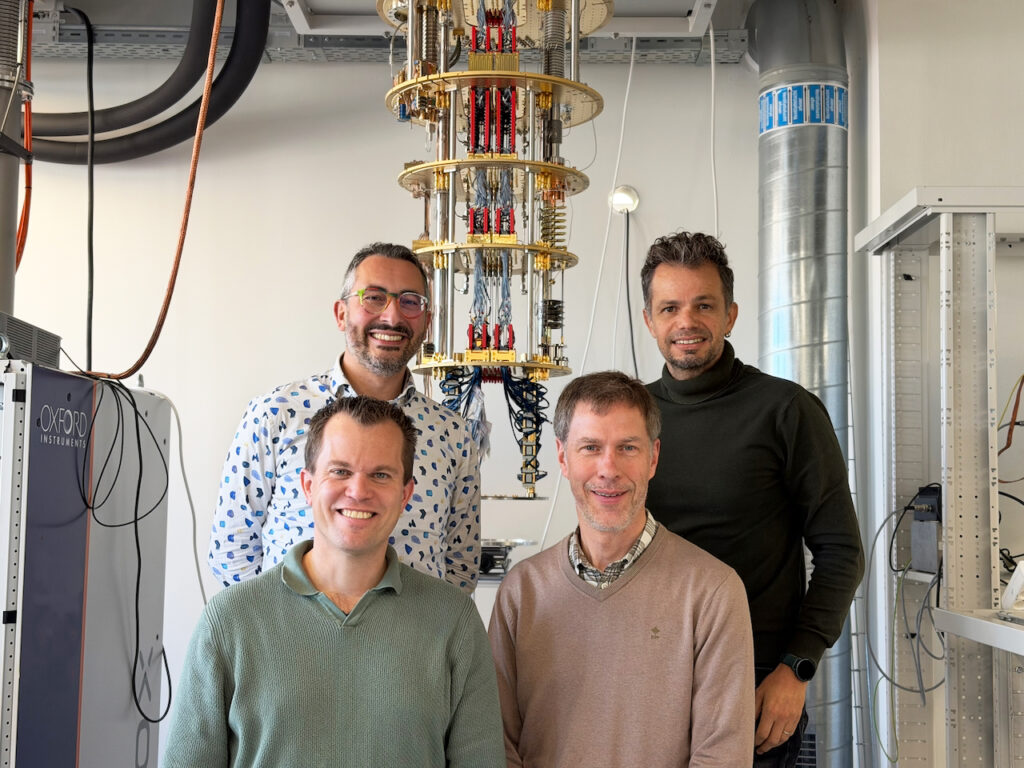
From left to right: Fabio Sebastiano, Giordano Scappucci on top. Menno Veldhorst and Lieven Vandersypen at the bottom.
Where materials and electronics meet
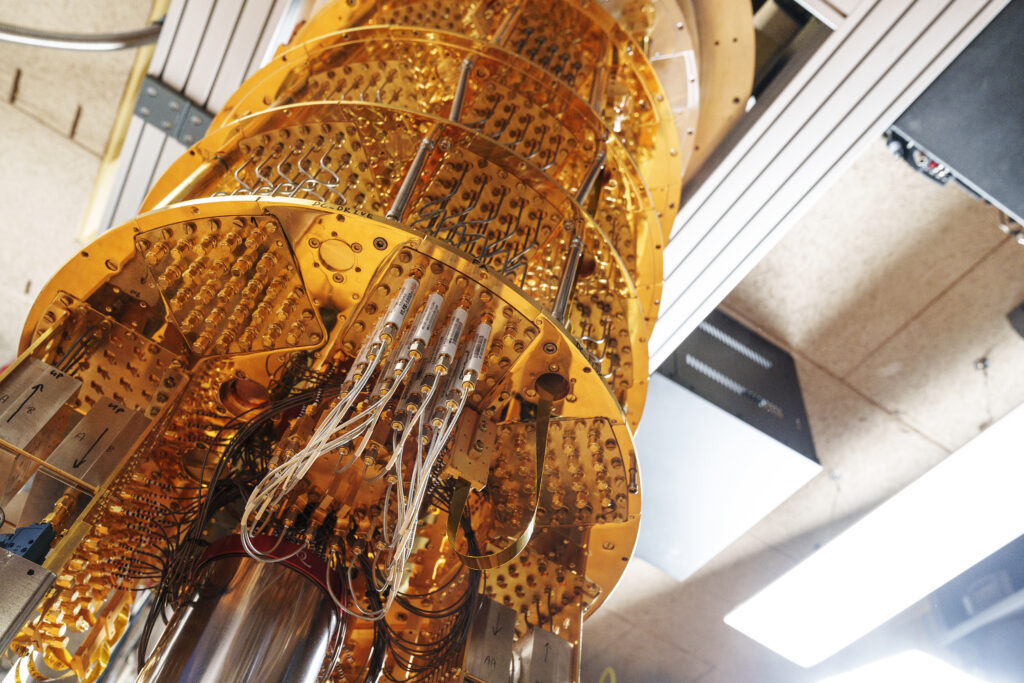
As more qubits are brought together, however, the equipment needed to operate them begins to crowd the picture. Today’s experiments often require several electrical connections per qubit, carrying control and measurement signals between the processor, deep inside a refrigerator, and equipment outside it. The qubits themselves may be tiny, but their supporting hardware quickly occupy an impractical amount of overhead. UniQ aims to bring selected electronic functions onto the quantum chip, where circuits could distribute control signals and amplify faint measurement signals before they leave the device. This links quantum physics to Fabio Sebastiano’s expertise in electronics: his circuits must fit beside the qubits and work at extremely low temperatures, where even small amounts of heat matter. “The qubits and electronics can help make each other’s job easier,” says Sebastiano. “If we can make the qubits less demanding to operate, we can give them smaller, simpler circuits that dissipate minimal power. Those circuits can then help us control more qubits with fewer connections to the outside world.”
The material beneath both is central to that relationship. Giordano Scappucci will engineer germanium structures that provide quiet, consistent surroundings for the qubits while also supporting the transistors from which their electronics will be built. This involves controlling the material’s purity and structure, reducing sources of unwanted electrical and magnetic disturbance, and tailoring different regions for different functions. An improvement here can travel through the entire design: qubits that behave more uniformly require less individual adjustment, easing the burden on their control circuits. “Every qubit that behaves differently asks something extra of the control system,” says Scappucci. “Improving the material therefore changes what we can build on top of it. We want to create the conditions in which both the qubits and their electronics can perform well.”
Giving qubits room to move
Veldhorst’s research will explore how the qubits themselves can further ease that burden. His team will develop ways to operate them using voltage pulses while relaxing demanding timing requirements placed on the electronics. Such changes reach beyond the physics of an individual qubit: simpler control could reduce the size and power consumption of Sebastiano’s circuits, making it more practical for them to share a chip with the quantum states they must protect. Materials development, qubit design and electronic engineering will consequently advance through a continuing exchange, with discoveries in one field changing the possibilities in another.
The layout of the chip offers another opportunity for these fields to meet. UniQ will study whether spin qubits can be moved around in arrays to create high connectivity between qubits, while also creating space for their supporting electronics. The resulting connections could make it possible to use error-correction schemes that need fewer physical qubits to create a logical one—a prospect that gives the engineering of movement a direct role in the pursuit of reliable quantum computing.
Putting the whole chip to the test
Whether these possibilities can coexist on one chip will be explored through experiments led by Lieven Vandersypen. Integration tests will begin from the outset, allowing the teams to discover how nearby electronics affect the qubits, how control signals change as they pass through circuits, and where adjustments to the materials or device design could improve the whole system. The project’s ultimate ambition is an integrated chip hosting a large spin qubit array with integrated pre-amplifiers and electronics for routing signals, providing a setting in which to investigate both the architecture and its use for error correction. “What makes this exciting is that progress in one area can unlock something in another,” says Vandersypen. “A better material can simplify a qubit, and a simpler qubit can make a smaller circuit possible. Our experiments will tell us how far we can take that together.”
An ERC Synergy Grant is designed for precisely this kind of closely connected research, supporting ambitious questions that require two to four principal investigators to combine their expertise. The competition is demanding: the 2026 call attracted 957 proposals, with funding initially planned for around 50 grants. For the Delft team, the award provides six years to pursue both bold ideas and the small engineering decisions on which a quantum chip depends. The aim is to establish an integrated building block that future processors could repeat and connect, carrying the ingenuity of semiconductor engineering into the development of reliable logical qubits.