05.11.2026Quantum Computing
Developed in Delft, tested in Delft: local quantum algorithms meet local quantum hardware
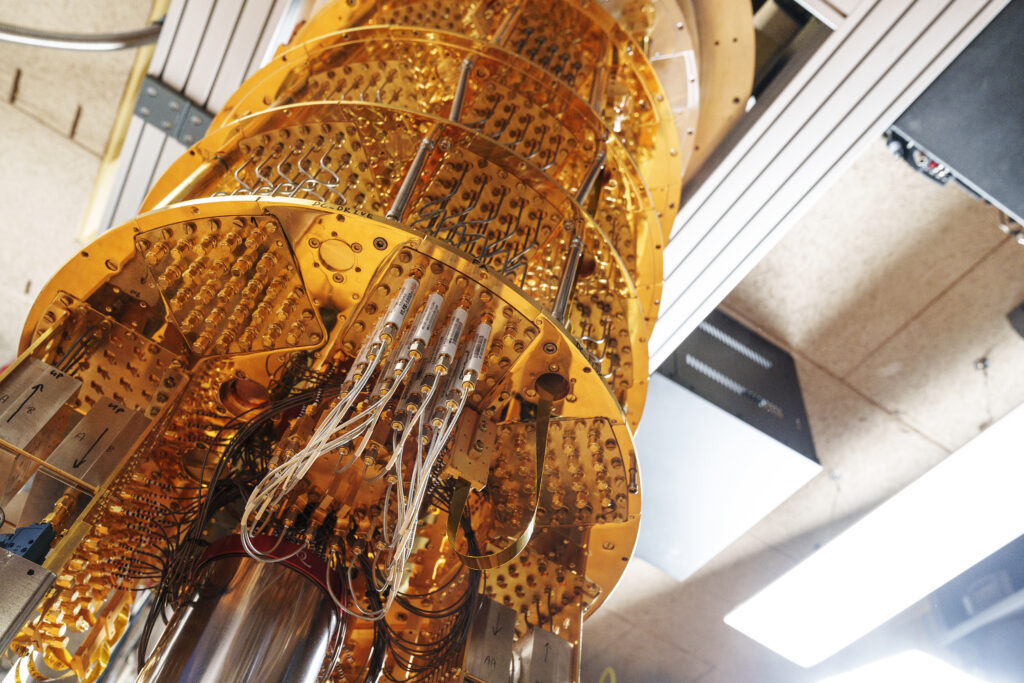

Researchers from the Quantum CFD Lab at TU Delft have run quantum algorithms for computational fluid dynamics (CFD) on quantum computers developed at QuTech, part of TU Delft. Using Quantum Inspire, TU Delft’s free, open, and cloud-based quantum computing platform, the QCFD team tested algorithms on real quantum hardware, rather than relying on simulators only. The experiments illustrate how quantum computers developed in Delft can already be used by researchers exploring the first steps of potential applications of quantum computing.
The experiments bring together different areas of expertise at TU Delft. Researchers at the Quantum Computational Fluid Dynamics (QCFD) Lab, led by Associate Professor Matthias Möller, are developing quantum algorithms that could eventually contribute to simulations used in aerospace, automotive, energy and transportation. By running their algorithms on QuTech’s Tuna-9 and Tuna-17 quantum processors, they were able to investigate how their methods perform on today’s quantum hardware. “It is still a long way before we can run meaningful CFD simulations on a quantum computer, but the opportunity to benchmark our codes at zero costs on QuTech’s on-premises quantum computers is very helpful to evaluate where we stand, even if our focus as a team is on advancing algorithms and methodologies,” says Matthias Möller.

Associate Professor Matthias Möller
Testing quantum algorithms in practice
The team has set up a quantum lattice Boltzmann simulation on a one-dimensional grid with eight grid cells, initialised all fluid in the left-most cell with the velocity pointing right, and let it stream passively for four timesteps. The figure below shows the ideal solution obtained on a perfect state-vector quantum simulator and compares it to the results obtained on the Tuna-9 and Tuna-17 quantum processing units (QPU) and a state-of-the-art commercially offered QPU to which the team had access through cooperation with one of the European high-performance computing centres. The compiled circuits consist of more than one thousand native gates, which is about the maximum that today’s NISQ machines can handle. One additional timestep yields a significant degradation of the results as shown in Figure 2.
Exploring quantum applications beyond QuTech
Alongside developing quantum hardware, QuTech aims to make quantum computing accessible to researchers from other scientific disciplines, all over the world. Through platforms such as Quantum Inspire, built with funding support from QDNL, NWO and Holland High Tech, and collaborations across TU Delft and beyond (TNO, TU Eindhoven, and others), QuTech enables research groups to gain hands-on experience with quantum processors and explore potential applications of the technology.
The collaboration with the QCFD Lab is one example of this approach. By bringing together QuTech’s quantum computing expertise and hardware with the QCFD team’s expertise in computational fluid dynamics, researchers can test new algorithms on real quantum processors, explore their limitations and contribute to the development of future quantum applications.




Figure 2: Results after five timesteps.

(a) Perfect state-vector simulation

(b) Execution on Tuna-9 QPU

(c) Execution on Tuna-17 QPU

(d) Execution on state-of-the-art commercial QPU