29.07.2026Quantum Computing
The quantum bus goes round and round


Researcher


Researchers at QuTech have demonstrated a semiconductor quantum circuit in which moving qubits plays an active role in processing quantum information. In the experiment a single qubit travels across a silicon chip to connect with four others, collecting information needed to check for errors without disturbing the processor. It shows how movement can make quantum chips easier to connect, less crowded, and more realistic to scale up. The results are published in Nature.
In a new silicon-based quantum processor, a single-electron spin qubit travels through a shuttling bus to transfer quantum information on-chip. Along the way, it visits four other spin qubits parked in adjacent “bus stops”, interacts with them one by one, and then returns to be measured. This makes it possible to check the four qubits together: a key operation for quantum error correction.
The shuttling worked well in this demanding setting. While operating the device as a five-qubit processor, the largest errors did not come from moving the qubit, but from the interactions between pairs of qubits. “The important step here is not just that we can shuttle a spin qubit well,” says Brennan Undseth, PhD candidate at QuTech, part of Delft University of Technology, “it is that we can use it as part of the quantum circuit.”
A bus for spin qubits
The central operation in the experiment is called a parity check. It is a way of asking a group of qubits a simple question: are they in an even or odd configuration? That question may sound abstract, but it is one of the basic tools of quantum error correction. A quantum computer cannot simply copy and inspect its qubits, because direct measurement would destroy the information stored in them. Instead, it must look for error signals indirectly. Parity checks provide those signals.
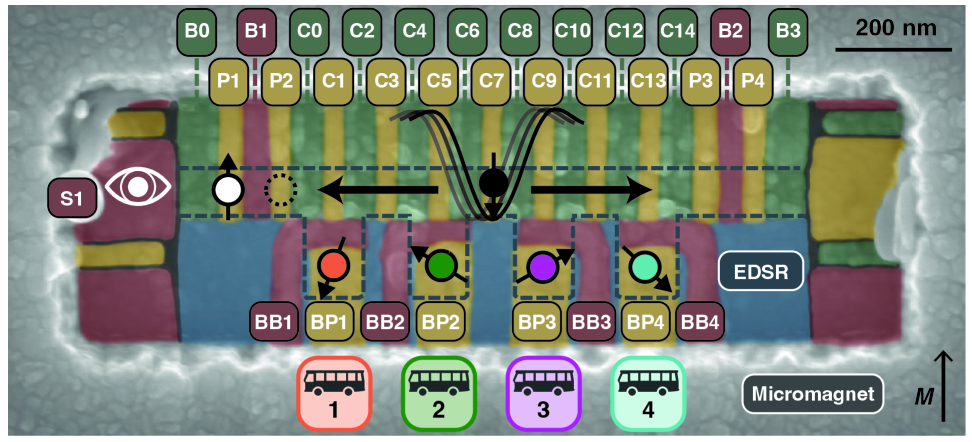
“For a parity check, one ancilla has to collect information from several data qubits,” says Undseth. “The challenge is to get that information out without disturbing the quantum state you are trying to protect. Shuttling gives us a natural way to do that. We bring the ancilla to the data qubits, instead of forcing every qubit to sit next to the ancilla qubit.”
That is conceptually very different from traditional spin-qubit devices, where electrons sit in stationary quantum dots. This makes them highly controllable, but it also limits which qubit can interact with which. Adding readout structures and control lines nearby can also make a dense chip crowded. The new device is built differently. It has a readout zone, a shuttling bus, and four stops along that bus. Four data qubits sit at these stops, where they store quantum information. A fifth qubit, called the ancilla, can move along the bus, and successively interact with the four data qubits. Next the ancilla is measured, and the result reveals the parity of the group as a whole, without directly measuring each individual data qubit, a critical requirement for quantum error correction.
The important step here is not just that we can shuttle a spin qubit well, it is that we can use it as part of the quantum circuit.”

The experiment also shows that shuttling can do more than carry a qubit from one place to another. In this device, much of the array is outside the range of direct charge sensing. “This is like exploring a dark cave without a flashlight.” The researchers therefore use the moving spin itself as a probe. By measuring how the spin responds to the environment, they can learn what happened far away from the sensor. The spins become our night-vision goggles. “What I find exciting is how shuttling fundamentally changes how we operate the processor,” says Undseth. “We use it to populate the array, we use it to tune the device, and we use it to run the circuit. That is very different from treating shuttling as a standalone operation.”
Towards error correction with spin qubits
For Lieven Vandersypen, the result changes what researchers can realistically design: “Spin qubits are attractive because they are small and compatible with semiconductor fabrication,” says Vandersypen. “But small qubits also need a scalable way to connect to each other. This experiment shows that shuttling can provide that connectivity inside an actual quantum circuit.”
The picture is becoming clearer: we can use shuttling as a credible route towards scalable error correction.
Instead of asking every part of the device to do everything, future processors could have different zones for different tasks: storing qubits, making them interact, and reading them out. Shuttling would connect those zones. Other quantum computing platforms like neutral atoms and trapped ions are also making use of these ideas, but semiconductor spin qubits are much smaller and can be moved much faster.
The next step is to use the same idea in larger circuits and in full quantum error-correction protocols. That will require more mobile-qubit and readout resources, as well as better two-qubit interactions. But the experiment suggests that shuttling can become a central part of how silicon spin-qubit processors are built.
“There is still engineering to do,” says Vandersypen. “But the picture is becoming clearer. We can use shuttling to connect the right qubits at the right time, and that gives spin qubits a credible route towards scalable error correction.”
Want to know more about spin qubits? Watch our new documentary, in which QuTech researchers explore everything from the fundamentals of how spin qubits work to the use of machine learning for qubit control.