25.06.2026Quantum Internet
Coherent coupling of diamond colour centre to a nanocavity

Researcher

A Step Toward Faster Quantum Networks
Future quantum networks will depend on reliable handshakes between two very different carriers of quantum information: solid-state qubits that can store and process information, and photons that can carry it between distant nodes. A team of researchers from QuTech has demonstrated an efficient and coherent interface between a diamond-based quantum emitter and photons trapped in a nanoscopic optical cavity. This is an important step towards future connections between quantum processors that are both fast and reliable. They also demonstrated near‑complete control over transmitted light and showed that their fabrication approach works across hundreds of cavities: an encouraging sign for scaling up. The results are published in PRX.
Today’s classic internet sends information as bits. A future quantum internet, however, would send and distribute quantum information in qubits. This allows for radically new applications in secure communication, blind access to quantum computers, and ultrafast coordination for network traffic load balancing. To make that work in practice, each network node needs a highly reliable interface between matter qubits on a chip that can store and process information and light that enables dynamic and long-range links between nodes.
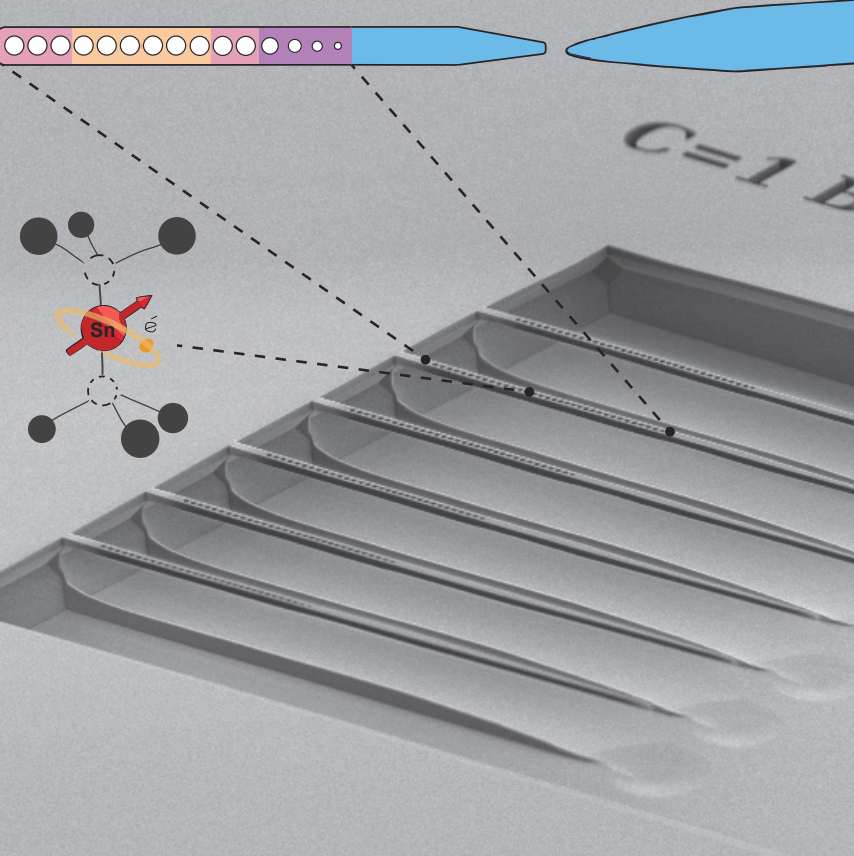
Electron microscope image of the diamond nanophotonic device. The colors in the schematic show the cavity: light purple are mirrors, yellow is where the light is confined and dark purple is the crossover region into the broadband optical waveguide (blue).
One promising route uses colour centres in diamond: controlled imperfections in an otherwise regular lattice of carbon atoms. In a tin-vacancy centre, usually abbreviated as SnV, a tin atom is incorporated into the diamond lattice together with missing carbon atoms. This SnV centre behaves like an atom‑like quantum system inside a solid, giving it properties highly useful for networking such as the ability to store and process quantum information, as well as an intrinsic interface to light. Very recent work has demonstrated exciting progress toward using SnV‑based systems as network‑ready building blocks.
By combining SnV centres with optical cavities that trap light, powerful protocols for linking network nodes become available. But there has been a key challenge: even if a defect emits light, these protocols need the interaction with light to be coherent—meaning the photon and the emitter “stay in step” long enough to perform quantum protocols without being washed out by noise. Achieving that coherence is especially challenging in nanophotonic devices, where the emitter must withstand nearby noise and where fabrication must consistently produce high‑quality structures.
The researchers built diamond photonic crystal cavities—tiny structures that trap and concentrate light—and investigated SnV centres that were embedded close to where the trapped light is strongest. They report a scalable fabrication outcome: across two separate chips they measured 327 devices with a high average quality and yield—important because future quantum networks will need many such devices, not just one.
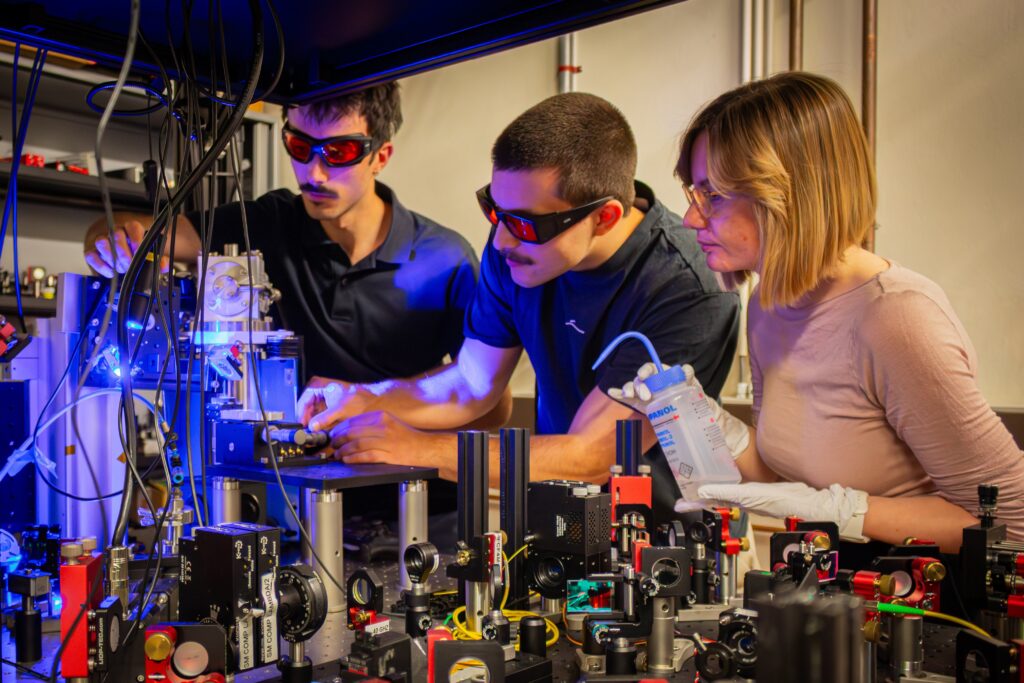
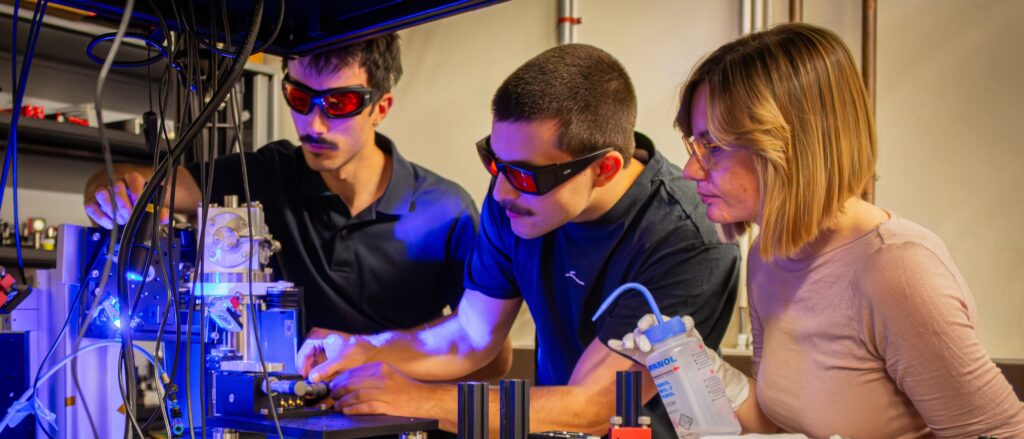
Researchers Nina Codreanu, Tim Turan and Daniel Bedialauneta Rodriguez at the experimental setup.
In two highlighted devices, the cavity made the SnV emit photons much more strongly into the desired optical mode. Furthermore, when tuned into resonance, a single SnV could almost completely shut off light transmission through the cavity, showing that one quantum emitter can strongly control a beam of light particles. Finally, by measuring optical linewidths (a way to quantify how “sharp” and stable the interaction is), they demonstrated coherent cooperativities above one, a widely recognized threshold indicating the system is operating in a regime suitable for high‑fidelity quantum operations rather than merely bright emission.
Reaching above‑unity coherent coupling is a practical milestone. Ronald Hanson, who supervised the research, explains: “This result signals that useful quantum interactions can dominate over dephasing noise, opening the door to faster and more reliable entanglement generation between remote nodes. Furthermore, in the context of our quantum computing collaboration with Fujitsu, this result is important for efficiently linking qubit modules into one large computer.”
This research benefitted from financial support from the joint research program “Modular quantum computers” by Fujitsu Limited and Delft University of Technology co-funded by the Netherlands Enterprise Agency under project number PPS2007, from the Dutch Research Council (NWO) through the Spinoza prize 2019 (project number SPI 63-264), from the Dutch Ministry of Economic Affairs and Climate Policy (EZK) as part of the Quantum Delta NL programme, from the Quantum Internet Alliance through the Horizon Europe program (grant agreement No. 101080128) and from The Kavli Foundation through the Kavli Institute Innovation Award “Quantum Materials for Broad-Band Quantum Transduction”.