09.04.2026Quantum Computing
Bringing back a phase from the many-body world


Researcher


Modeling an experiment on a single qubit is relatively straightforward. You prepare a state, let it evolve, and read it out. But once several particles start interacting, things quickly become much more complex. Even models that look simple on paper can become hard to solve. Researchers at QuTech now show a practical way to step into that many-body world without losing the ability to measure what happens. Using a 2×4 array of gate-defined quantum dots, they perform spectroscopy of up to eight interacting spins with a protocol that maps many-body dynamics back onto a clean, qubit-style readout. The results are published in Science.
The core challenge is not that many-body systems are random, but that they can be opaque. The relevant information is global, encoded in collective eigenstates and energy splittings that are hard to access directly. The team’s solution is many-body Ramsey interferometry. They start where control is easiest, venture into the interacting regime where the physics is richest, and then return with a measurable phase. As first author Daniel Jirovec puts it, “we tried to chart a course to connect the ‘qubit world’ to the many-body regime, because that’s where the interesting physics lives.”
Engineering eight spins into one controlled many-body system
Concretely, the experiment begins in a setting where each spin behaves like an individual qubit, that the researchers can reliably prepare and measure. They then slowly turn on the couplings between neighbouring spins so the spins stop acting independently and start behaving as one connected system. In this way, they can create a controlled superposition and maintain it up to the many-body regime, effectively preparing the system in two different configurations at once. The two configurations have different energies, which implies that one accumulates phase faster than the other. When the researchers slowly turn the couplings back down again, they return to the simple readout setting, where those two versions interfere. The interference shows up as a clean oscillation in the measurement signal, and the oscillation frequency is a direct measure of the energy difference between the two many-body configurations.
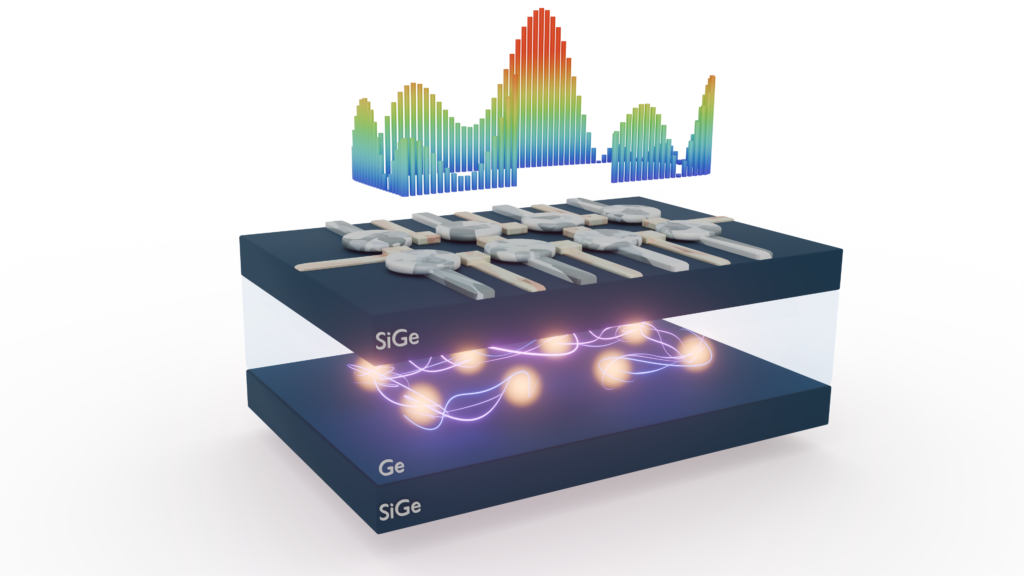
Artistic rendering of the quantum dot device used to confine eight interacting spin qubits. The many-body interferometry developed in this work allows access to the spectral fingerprint of their collective quantum state, illustrated above the device.
The milestone is not just measuring a pair of spins, but treating eight spins as one engineered object. The authors build up the experiment from shorter chains and culminate in an eight-spin chain in their 2×4 array, precisely the regime where the spectrum densifies, and simple intuition starts to fail. That demands stability and repeatability. Several exchange couplings must be activated together, kept steady, and revisited across many settings so that subtle frequency shifts remain meaningful. That experimental discipline took time. Co-author Stefano Reale, postdoc at QuTech, explains that the platform’s combination of fine tunability with stability, proved crucial for this challenge: “This type of research takes discipline and time, and so it makes a huge difference that this platform allows to tune the exchange couplings very precisely, and keep the device stable, while we follow the system from the isolated qubit regime into the interacting many-body regime. That way we could record a full set of time traces for one interaction setting in about eight hours, with each trace taking only one to two minutes.”
Chaos comes with meaning
Eventually, with reconstructed spectra in hand, the team looked for global fingerprints that emerge as interactions outrun disorder. In a localised regime, levels are comparatively uncorrelated. In a chaotic regime, they develop correlations and level repulsion, statistical structure that signals a qualitative change in many-body behaviour. Quantum chaos does not imply the device is misbehaving, or that information becomes meaningless. Jirovec emphasises that the system is not chaotic in the everyday sense. It “behaves systematically,” he explains, “it’s just no longer easy to understand the systematics.” The difference now is that the team has a way to probe those systematics through the spectrum itself.
This work sits right at the interface between two things quantum technology needs simultaneously: precise control, and realistic many-body physics. It shows how a deeper understanding of microscopic quantum rules connect to thermodynamics-like behaviour in interacting systems. And finally, how that can lead to better quantum applications.