20.03.2026Quantum Computing
Bespoke neural network to tackle fundamental physics

Researcher

There is somewhat a paradox in quantum computing: to make better devices, we first need to understand the realm of quantum mechanics better – however, we lack the computational power, that quantum computers themselves are meant to deliver, to run the simulations and models that build that understanding. New work from QuTech and ETH Zürich points to a way out of that loop: neural networks, designed with the right physical constraints, to accurately deduce quantum states.
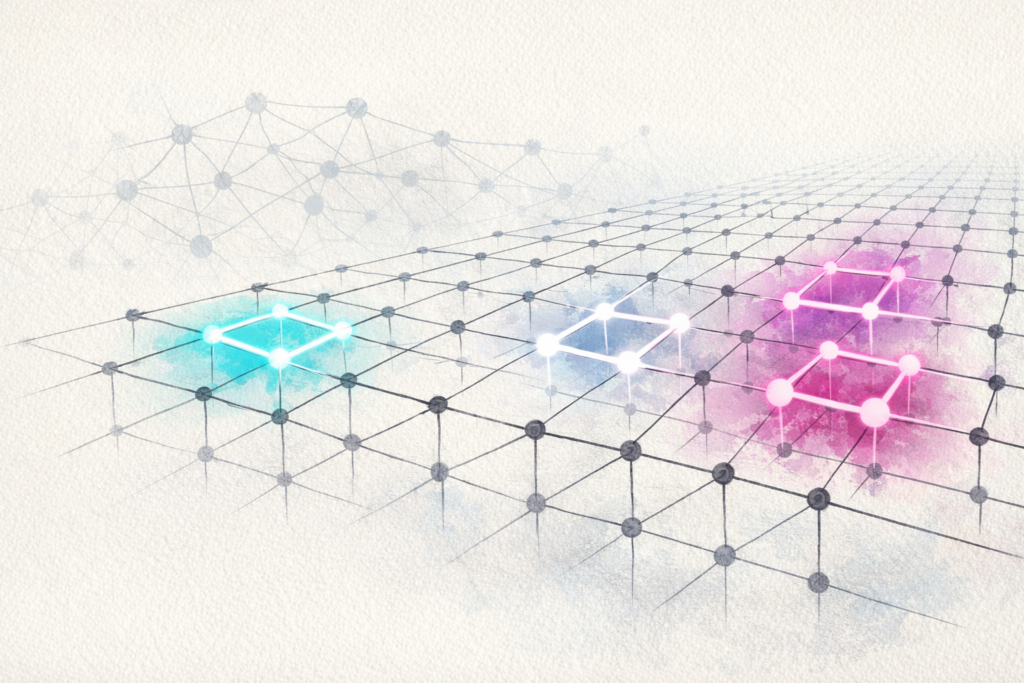
The team tackled a notorious test case from particle physics called a lattice gauge theory. In this approach, space is replaced by a grid. The “field” is stored on the connections between neighbouring grid points, and the theory comes with a built-in freedom to locally relabel the description at every grid point without changing anything measurable. That freedom is essential to the physics, but it also makes computation treacherous: an algorithm can waste effort trying to model differences that are not physically real.
“A lot of what the computer considers is just different ways of writing the same situation,” says Thomas Spriggs (QuTech). “So we designed the neural network to automatically ignore non-physical changes, and to spend its learning capacity on the features that actually determine the energy.” The goal is to find the ground state, the lowest energy quantum state of the model. The method uses a feedback loop where the neural network represents a candidate quantum state, many field configurations are sampled, and the network is trained to assign higher weight to configurations that reduce the energy. “The laws of physics give us the score,” Spriggs explains. “The network proposes how likely each configuration should be, we compute the energy that implies, and we train it until it reliably prefers lower energy states.” A key point is what the method avoids. The researchers keep the field description fully continuous, rather than simplifying it into a smaller approximate set, and they build the symmetry constraints directly into the architecture, so they hold exactly throughout training. They also work in the Hamiltonian formulation, where time can remain real and continuous, and they emphasize that the approach avoids both discretization of the gauge field and the sign problem.
Across two- and three-dimensional versions of the model, the learned states reach lower energies than a purely symmetry-based baseline and reproduce established theoretical expectations where those are available. Eliška Greplová, principal investigator at QuTech and associate professor at TU Delfts Quantum Nanoscience group, highlights why this matters: “If quantum processors are going to simulate nature in regimes where classical methods struggle, we need trustworthy reference calculations and clear validation targets” they say. “This work strengthens that foundation, and it shows how machine learning can help us explore the physics that future quantum computers will ultimately aim to reproduce.”