26.02.2026Quantum Internet
NWO Vici grant for Tim Taminiau: quantum networks that stay entangled

Researcher
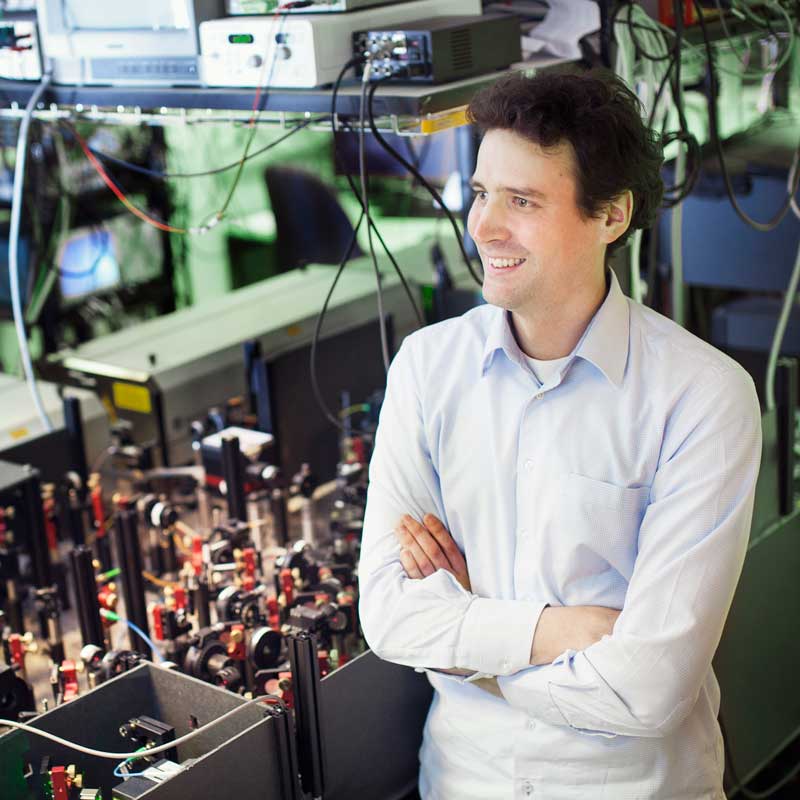
Tim Taminiau has been awarded a NWO Vici grant to take the next step in quantum networking: moving from occasional entanglement between devices to multi-node networks in which entanglement is continuously available. The QuTech project, titled “Sustained entanglement over solid-state quantum networks”, aims to develop silicon–carbide devices to create multi-node entanglement links that can be replenished faster than they decay.
Entanglement is the key ingredient that makes a quantum network fundamentally different from a classical one. But it is also fragile: while you are trying to distribute new entangled states, previously stored quantum states can quietly lose their coherence. For solid-state quantum devices, that tension is now one of the main bottlenecks holding us back from scaling to larger and more capable quantum networks.
Tim Taminiau
Always entangled
Tim Taminiau, group leader at QuTech, aims to tackle this bottleneck by developing devices that combine a fast entanglement creation through an efficient optical interconnect, with robust long-lived memory to store quantum states. The goal is to reach a regime where new entanglement is created faster than existing entanglement disappears. “Right now, we can create entanglement in a probabilistic way. When you don’t succeed early enough, all previously created quantum states in the network are lost, forcing one to start all over,” Taminiau explains. “My goal is to create entanglement much faster than it is lost, so that it becomes possible to use many entangled states to connect larger networks and perform more complex computations.”
Why silicon carbide?
To reach this goal, Taminiau will use spin qubits based on silicon-vacancy (VSi) qubits in silicon carbide (SiC), a relatively new type of quantum bit that might prove to be advantageous for scaling to large networks. SiC is an industrially mature semiconductor with advanced nanofabrication for photonic and electronic devices. Additionally, the VSi qubits operate at high temperatures up to around 20 Kelvin, which could make it more practical to scale hardware compared to other platforms that require much colder conditions.
The plan is to create network nodes with several qubits, not just one. Each node combines an electron-spin “communication” qubit (the VSi center) to distribute entangled states between nodes, with a register of nuclear-spin qubits that can store and process the actual quantum states used in computations. “This combination of fast entanglement rates, robust quantum memory, and scalable device fabrication might be the key to more complex networks,” Taminiau says. “It then becomes possible to investigate advanced protocols, such as entanglement distillation and distributed quantum error correction, which can ultimately be used to overcome imperfections and realize large-scale quantum networks.”