15.01.2026Quantum Internet
More Photons, Faster Links: a laser-focused NV centre

A reliable quantum internet will require network nodes that can generate and share quantum information at high rates. One of the main bottlenecks today for the commonly-used diamond nitrogen-vacancy (NV) centre qubit is the low number of useful photons produced. An improvement developed at QuTech, published in Nature Communications, could significantly raise future entanglement rates between distant NV quantum systems and make practical quantum networks more realistic.
In state-of-the-art solid immersion lens devices used for remote entanglement generation between NV qubits, the resonant photon collection probability is about 0.05 percent per attempt. This limits how often two distant nodes can become entangled. Researchers at QuTech have now demonstrated a device that boosts this probability by about ten times to 0.5 percent and that brings together, in a single platform, all core ingredients of a cavity-enhanced diamond quantum network node.
The team integrated a single NV centre into an open, fibre-based Fabry–Pérot microcavity. This microcavity is formed by two highly reflective mirrors facing each other, one on a chip and one on the tip of an optical fibre. The distance between the mirrors sets a resonance that can be tuned to the NV centre’s optical transition. In this setting, network-ready zero-phonon line photons are far more efficiently extracted than in solid immersion lens devices, because the cavity both boosts emission into the desired optical line and directs it into a well-defined mode that can be collected.
The team fully characterised the optical interface, showing that the cavity strongly enhances emission into the zero-phonon line, and confirmed high-quality single-photon behaviour. They also demonstrated optical control of the NV centre for qubit initialization and readout and coherent microwave control of the spin qubit, and used the system to generate spin–photon states. Together, these functionalities form the basis of a complete quantum network node.
A brighter pathway for network photons
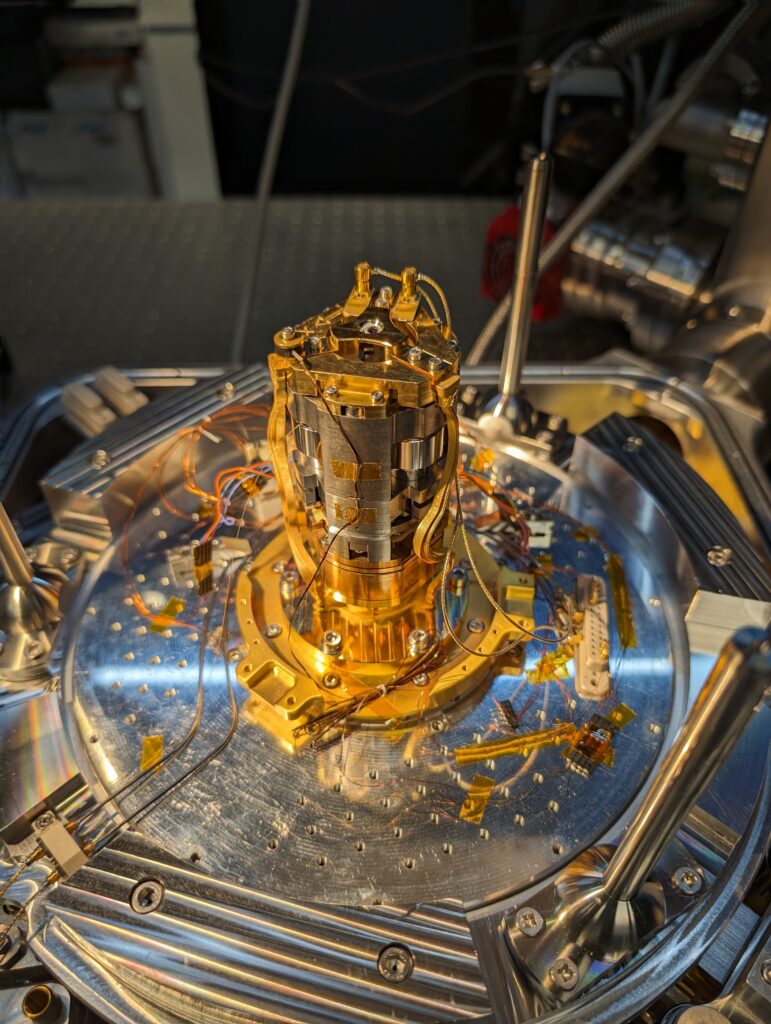
The inside of the cryostat used for the experiments. The cylindrical stack is the positioning system that controls the microcavity system at its top.
“Suddenly we have access to far more of the photons that really matter for networking,” says first author Julius Fischer. “Every additional photon directly increases how fast we can create entanglement between distant nodes. We are no longer limited by the traditional brightness of NV centres.” While the current probability is 0.5%, measurements indicate that, with improved optical excitation, the same device could reach detection probabilities above one percent per pulse. This would mark an important step toward scalable quantum repeater designs.
To maintain the NV centre as a reliable qubit, the researchers integrated a microwave stripline into the mirror substrate. This enables fast and coherent spin rotations at about ten megahertz. Ramsey and Hahn-echo measurements confirm that the spin remains coherent for more than hundred microseconds when protected by echo sequences, which is sufficient for the timing demands of spin-photon state generation.
“The key achievement is that we improve the optical interface without sacrificing the qubit,” explains co-author Yanik Herrmann. “The spin stays coherent, the microwaves still work, and we gain a major increase in usable photons. That balance is what makes this platform relevant for quantum networking.”
Demonstrating spin–photon correlations
With the optical and spin control in place, the team tested the full capability of the node. They used resonant pulses through the cavity to initialise and read out the NV centre’s spin, combined with microwave gates to create and manipulate superposition states. On top of that control, they generated single photons correlated with the NV centre’s spin state, encoded in early and late time bins, which is a suited encoding for remote entanglement generation.
They then extended the sequence to a three-qubit GHZ state generation consisting of the spin and two photons and observed the expected heralded correlations between photon arrival times and spin outcomes. These experiments showed that the platform is not only brighter but also fully functional as a cavity-enhanced spin–photon interface suitable for quantum networking.
The road ahead lit up
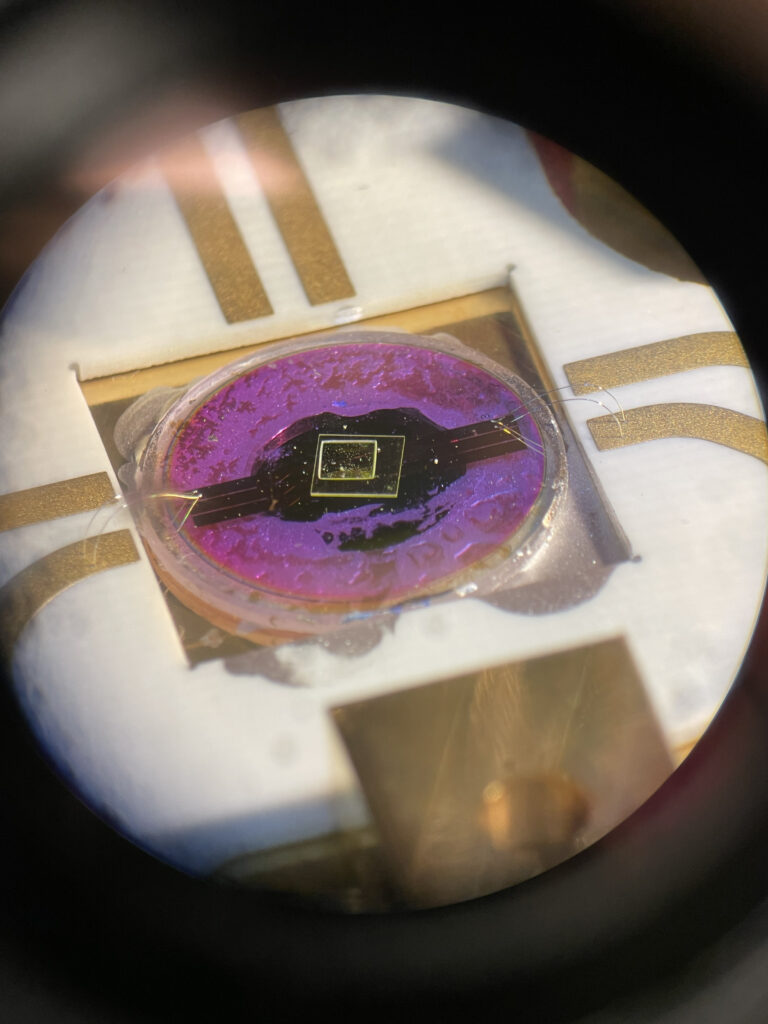
An exemplary microcavity mirror with a bonded diamond membrane and on-chip microwave striplines. One stripline is connected with wirebonds to a printed circuit board that surrounds the mirror.
Ronald Hanson, principal investigator, places the work in context. “For years, the community has known that NV centres have the right stability and coherence for quantum networks. What held us back was the limited number of useful photons we could extract. This work shows a path to overcoming that barrier. A brighter and still coherent NV centre can lead to faster entanglement generation and, eventually, more capable quantum networks.”
The same concepts can also be applied to other solid-state spin systems. By increasing the rate at which solid-state qubits emit useful photons, this cavity-enhanced platform addresses a key practical limitation in quantum networking. It brings the field closer to quantum links that operate quickly and efficiently enough for long-distance communication and distributed quantum computing.