13.10.2026Quantum Internet
A quantum setup moves from Delft to Karlsruhe

After fourteen years of research in the Hanson Lab at QuTech, an experimental research line into open microcavities for diamond colour centres recently came to an end. Five generations of PhD researchers worked with and further developed the platform and its experimental setup. But rather than putting the equipment into storage, the team looked for a research group that could continue to make use of it.
That opportunity was found at the Karlsruhe Institute of Technology (KIT) in Germany. The newly started group of Tina Müller at the Institute of Applied Physics works with solid-state quantum emitters, including quantum dots at telecom wavelengths, making the setup well suited to their research. The complete experimental system was therefore prepared in Delft, transported to Karlsruhe and installed in its new laboratory in the KIT physics tower.
A flexible but sensitive platform
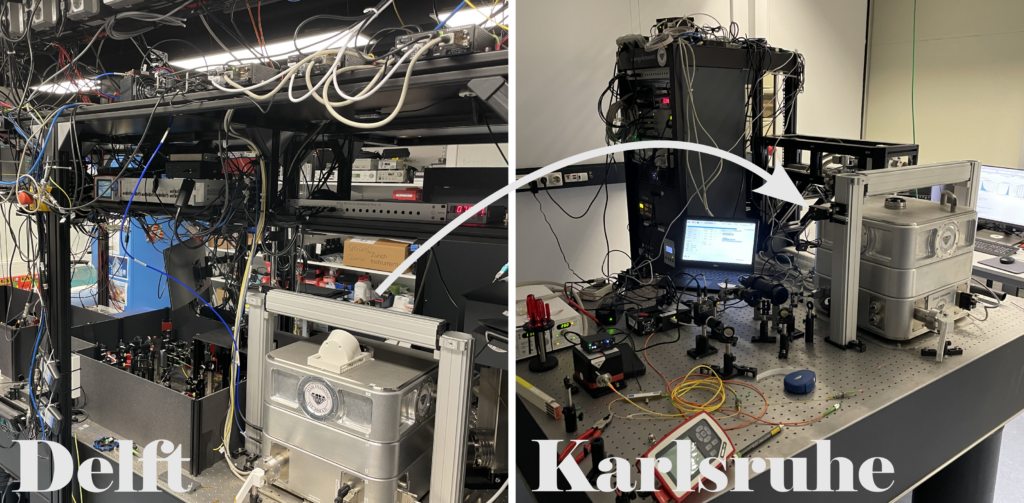
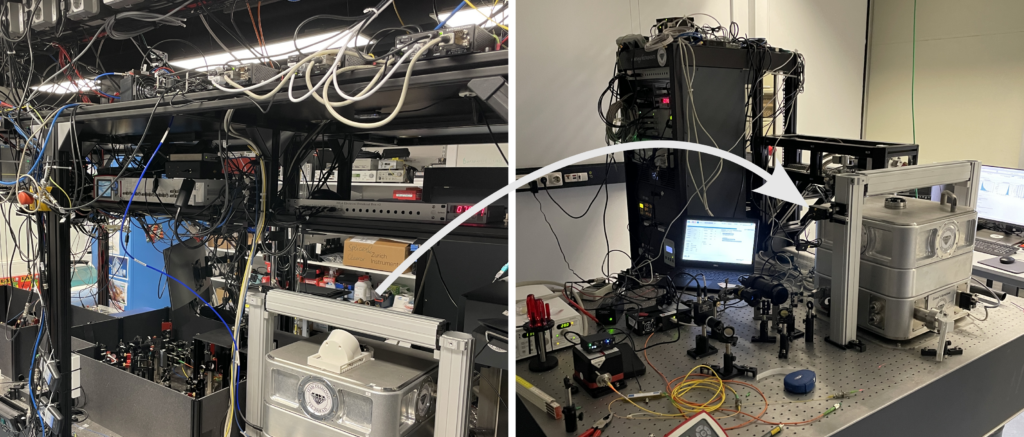
1) The quantum setup in the optical laboratories in Delft and in Karlsruhe. The main part is the metallic vacuum chamber, in which the microcavity is cooled to low temperatures.
At the centre of the setup is a fibre-based open microcavity platform, cooled in a closed-cycle cryostat to temperatures below 10 Kelvin. The main advantage of such a cavity is its wide spectral tunability. By adapting the coating of the mirrors, the platform can be made compatible with different types of quantum emitters and experiments.
This tunability also makes the system technically demanding. Open microcavities are highly sensitive to vibrations, reducing their performance, especially in a noisy, cryogenic environment. Over the years, considerable effort went into reducing the vibration level and creating sufficiently stable experimental conditions, finally approaching a passive stability of 25 Picometer (roughly the size of a single Helium atom).
As a result, the setup represented more than the individual pieces of equipment from which it was assembled. Its performance depended on how the complete system had been engineered and optimised. Transferring it to another laboratory therefore required careful preparation.
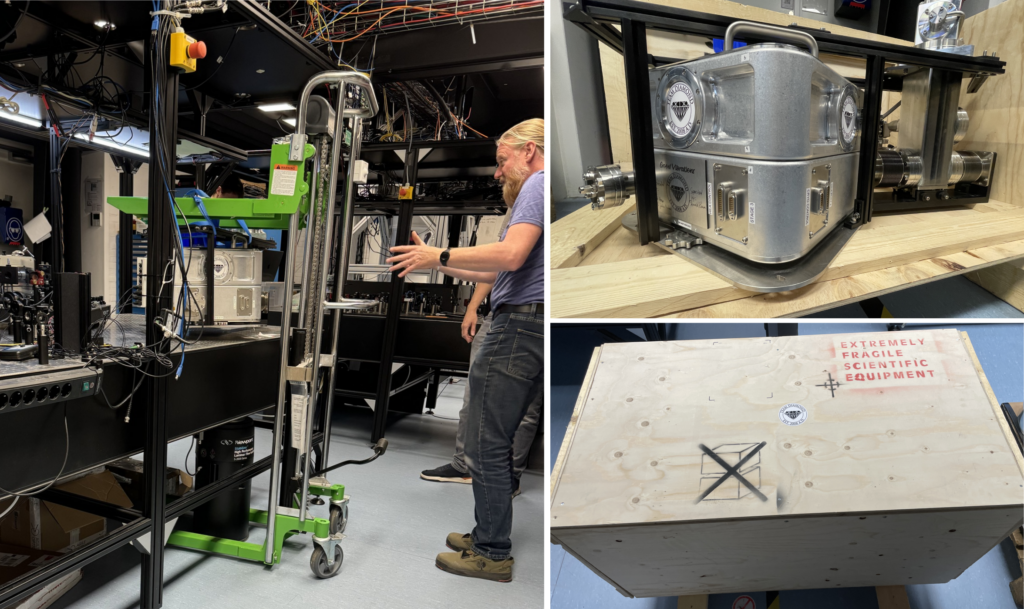
2) Decostruction and packing in Delft.The vacuum chamber weights more than 100 kg, which needs to be lifted with a small crane.
Preparing the move in Delft
The first stage was to make the complete system ready for transport. Cables were labelled, equipment was collected and the experimental chamber was prepared so that it could remain under vacuum during the transport. The team also prepared the control code needed to operate the setup in Karlsruhe.
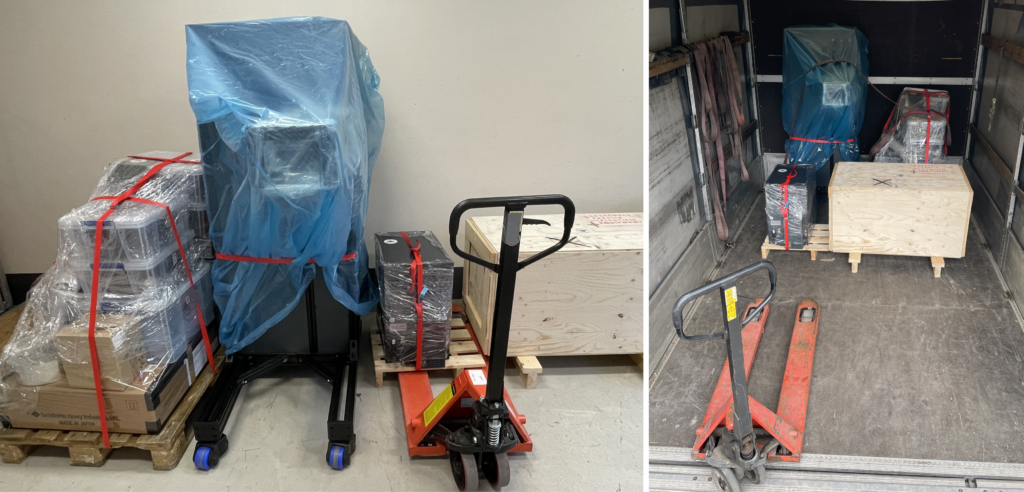
3) Transport to Karlsruhe. The entire setup consists of one 19-inch control rack, a compressor, the vacuum chamber in the wooden box and various additional equipment stored in boxes on the pallet. A shipping company delivered everthing in a truck to Karlsruhe.
The equipment was then packed into boxes and secured on pallets. Once everything had been prepared, the actual transport was relatively straightforward: the setup was shipped from Delft to Karlsruhe using a standard shipping company.
For a system that had been assembled and refined over many years, however, successful transport was only part of the process. The main question was whether it could be reinstalled in a different laboratory while maintaining the performance achieved in Delft.
Recommissioning the setup at KIT
In Karlsruhe, the equipment was installed in a new and initially empty laboratory. The team rebuilt the system and began testing it soon after arrival. Within one week, they had completed a test cool-down and carried out measurements of the vibration levels. The results showed that the setup performed similarly to how it had in Delft.
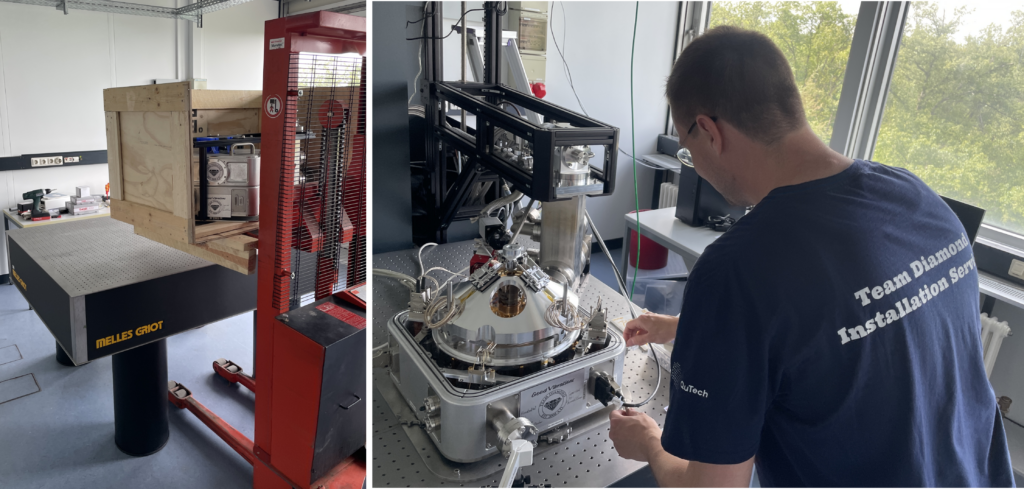
4) Installation in Karlsuhe. After lifting the vacuum chamber back on the optical table, the control rack could be connected. In the final step, the microcavity inside the vacuum chamber is assembled and tested.
This was particularly relevant for the cavity, where controlling vibrations is an important part of achieving stable operation. The measurements confirmed that the system had successfully made the transition between the two laboratories. With installation and initial testing complete, the setup can now be used for new measurements at KIT. The transfer keeps a specialised experimental platform in active research use after the research line for which it was originally developed has concluded.
Fourteen years of work in Delft have resulted in a mature system whose capabilities can now support a new programme of experiments in Karlsruhe.
Acknowledgement
A big thank you to the technicians from QuTech, in particular Vinod Narain and Siebe Visser, and from KIT, in particular Heinz Leonhard, for their help in moving and installing the system. Furthermore, we thank Rebecca Mayrhofer for taking care of the administrative part and Julius Fischer, Jan Riegelmeyer, Timo Dolné and Leonardo Wienhoven for their help during the move. We further acknowledge the research group of David Hunger at KIT in their support with setting up the system and testing it.