07.05.2026Quantum Computing
The qubit: there and back again


Researcher


Scalable semiconductor quantum processors will need more than good qubits. They also need a practical way to connect them. In a new study, published in Nature, QuTech researchers show that it is possible to entangle electron-spin qubits while they are on the move. They then used this capability to teleport a quantum state a short distance across the chip. Beyond moving electrons across the chip, the motion can control the quantum operations themselves, which opens up new ways to scale spin-qubit processors.
Setting up the conveyor belt
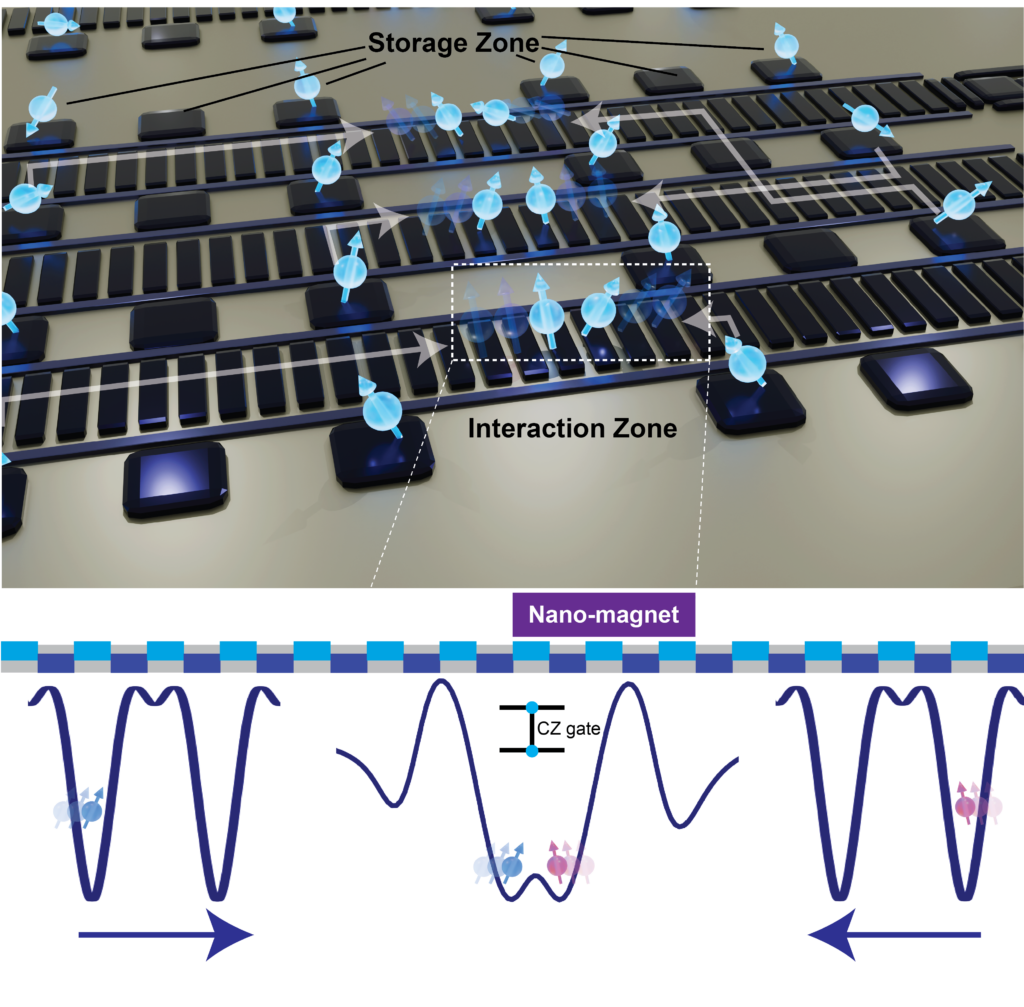
A spin qubit is the quantum state of a single electron’s spin, which you can picture as a tiny magnetic needle which encodes quantum information. On a chip, that electron is trapped in a “quantum dot”, a small pocket in the electric potential created by voltages on metal gates. By applying signals to a line of gate electrodes, the researchers create a traveling potential minimum, somewhat like a conveyor belt, bringing the qubit from one place to another.
This shuttling matters for scalable architectures because it lets qubits be brought together in a dedicated two-qubit operation zone and then separated again. “Qubits based on neutral atoms and trapped ions already had this functionality, now we can add spin qubits to the list,” says Maxim De Smet, first author of the paper and PhD candidate at QuTech, part of TU Delft. The relative flexibility of such a connection means we could ease scaling by reducing the amount of pair-by-pair coupling control you need across the array. Future conveyor lines could use shared control, allowing dynamic reconfiguration and interconnection of qubits. “We spent a lot of time making the conveyor smooth, without background potential disorder. Once the spin stays well confined in the moving quantum dot, you can use distance and timing as tunable parameters for the interaction, and you can trust what the readout is telling you,” explains De Smet, who led much of the experimental implementation.
Error correction is not only about the fidelity of a single gate. It is also about connecting qubits, and how much routing you need for that
Tunable parameters matter because the central operation in the paper is a two-qubit gate performed with qubits in motion. Two spins are loaded into separate moving confining potentials and transported toward the middle of the array. As they approach each other, their wavefunctions overlap and an exchange interaction acts on the spins. The interaction can be tuned by varying the qubit separation while holding the central barrier gate at a fixed voltage, operating in a regime that implements a two-qubit gate.
A form of dance

First author Maxim De Smet (L) and Larysa Tryputen of TNO (R) playing badminton, with the badminton shuttle moving in quantum superposition. Tryputen fabricated the device.
De Smet links that capability to a more elegant style of on-chip connectivity: “We envision this could lead to something like a ballroom dance, where qubit couples get formed, dance together for a while, part ways again, only to form a different couple with someone else later.” That more flexible movement, independent of barriers, takes the limelight when thinking about error correction. “Error correction is not only about the fidelity of a single gate. It is also about connecting qubits, and how much routing you need for that. Mobile spins let you create interactions where you want them, and thus translate into more efficient architectures for large semiconductor qubit chips,” adds Yuta Matsumoto, shared first author of the article.
Reading out the result turned out to be just as important as moving the qubits. “A practical part of the achievement is that we can read out what happened without ever having to measure a moving spin directly,” says Matsumoto. The qubits travel to fixed readout stations, where the chip can compare spins in pairs and convert that information into an electrical signal. “We put all these elements together in a demonstration of quantum state demonstration. It’s not a single dial that says quantum state ‘teleportation’,” he adds. “You piece it together from several outcomes across the full sequence, and that’s why keeping the conveyor and all other components stable over long runs was so critical.”
What makes semiconductor qubits so compelling is the prospect of building complex quantum hardware with the same mindset that drove classical chips forward
Zooming out and scaling up
The bigger picture is about what semiconductor platforms can offer if they keep scaling: dense integration, reliable fabrication, and a path from small demonstrations to chips with many functional zones. This work sets one more step along that roadmap, showing that computing controlled by the motion of qubits can support multi-step protocols on the same device. Senior author Lieven Vandersypen, chief scientist at QuTech and professor at TU Delft, puts that excitement in a broader picture: “What makes semiconductor qubits so compelling is the prospect of building complex quantum hardware with the same mindset that drove classical chips forward. If we can combine good qubits with scalable control and integration, silicon becomes a natural place to build large quantum systems.”